Monday, August 11, 2014

Los Criollos (The Peruvian Creoles)


Los Criollos (The Peruvian Creoles)

Oil on canvas - 4ft x 5ft.

Peruvian “Música Criolla” (Creole Music), is comprised of two essential instruments, the Cajón (http://en.wikipedia.org/wiki/Cajón) and a guitar.  They work together much like a human body; the thumping base of the cajón, a beating heart, the guitar strings, veins.Together, they create a “Jarana” (a revelry).“Musica Criolla” is much more than Perúvian music. It’s a symbol of culture, tradition and history. Peruvian Creole Music is a means of popular expression, and has produced many great musicians and songwriters. The musical and literary beauty is so inspirational, other great artists in different musical genres interpret many of its songs. 

Musica Criolla can be described as poetry, dancing to the rhythm of a guitar and a cajón.  A “Criollo” (Creole) carries music in his or her soul. To be a “Criollo” you have to be a lover of life and the streets. A Criollo falls in love with his street corner, and will sing there until the break of dawn. It goes far beyond knowing how to sing or play an instrument. You must be able to express your deepest feelings.

A “Jarana”, is a revelry or celebration. Most times, it’s spontaneous and improvised. It takes place in a house or in the street of any neighborhood, where friends, relatives and neighbors come join the celebration. When a Jarana takes place in someone’s home, the door is left open. No invitations or RSVP’s needed ...if you went, great, and if you didn’t go, you missed it. A Jarana sometimes occurs during a simple reunion where someone just brought a guitar and someone else showed up with a Cajón. And of course at a Jarana, there will be some criollo dish or dishes (Peruvian food). Also “Chelas” (slang for beer) is a great companion for the Criollos that sing, play instruments and of course, the Criollos that dance. I remember “Cristal”, the most popular beer brand back in the days, they come in enormous bottles, and many times you drink only from one glass that you share with your friends.

http://en.wikipedia.org/wiki/Música_criolla

Monday, September 2, 2013

The Emoliente Street Vendor

More Characters


The collection of Lima’s traditional characters keeps growing. One brushstroke at a time.

Wednesday, September 26, 2012

La Tamalera (The Tamale Street Vendor)


La Tamalera (The Tamale Street Vendor)
Oil on canvas 4ft. x 5ft.

It is an October cool sunday morning. The sky is grey as it usually is in Lima this time of the year. And she’s sitting on a little stool. This is how I remember the Tamalera (Tamales street vendor). As I was growing up in Lima, Perú it was very common to see a Tamalera very early in the morning, sitting by the door of a bakery selling her freshly homemade tamales. I remember she had a huge basket filled with tamales. And sitting on the top of the basket she had a piece of wood working like a shelf, where she would place a warm Tamale ready for you to taste and hopefully buy one, or two, or more, to take home and have a delicious breakfast.

In Perú, the “Tamal” is the type of food that fits perfectly in any of the four meals of the day, it is great for breakfast, for lunch, also for “Lonche” (a peruvian “tea time”, and also for the late dinner. (Lonche: http://perufood.blogspot.com/2006/01/lonche-english-tea-time-in-lima.html)

The “Tamal” makes any breakfast a traditional one. A Tamal sandwich on French Bread, accompanied by hot coffee or “Café-con-Leche” (coffee with milk) for breakfast or for Lonche, or a Tamal with “Salsa Criolla” on top , for lunch or dinner are very impossible for me to forget. (Onion Creole Sauce: http://southamericanfood.about.com/od/saladssidedishes/r/salsacriolla.htm)

This painting also depicts how I remember my neighborhood’s bakery, in the district of Jesus María where I grew up. The bakery was at about a block and a half from my house, we had to go and by bread twice a day, first thing in the morning for lunch, and late afternoon for “Lonche”. Where I grew up it was important to have freshly baked bread for every meal. French bread.

I really hope that this painting can tell you a little more about my culture and the customs and characters that were a big part of the Perú I grew up in.

Peruvian Tamal:

Sunday, February 5, 2012

Peruvian Art. El Heladero (The Ice Cream Man)

“El Heladero” is here. Oil on Canvas 4' x 5'. As many of you know, I grew up in Lima, Perú. And I remember very clearly every summer in which the streets would be invaded by the Ice Cream Men. Like warriors, pedaling or pushing this commercial tricycle they would make sure they found their way to you. The tricycle carried this big ice-box painted in a unmistakable yellow color, you could see them coming from far, far away. They also had this little air-horn that made this peculiar sound and they used to announce that they were around, so if you couldn’t see their yellow cart coming, you would definitely hear they were on their way.

The name of the brand of the ice-cream they carried was D’onofrio. The best and the most popular ice-cream brand at the time (http://en.wikipedia.org/wiki/D'Onofrio). They had a huge selection of different flavors and types of ice-cream, and I have to say, they were all really good. During the summer, you would find an “Heladero” in parks, street corners, beaches, etc. and they were either pedaling heir tricycle, or just waiting for you to come and buy ice-cream. There could never be a summer without it’s inseparable companion: El Heladero”.

With this painting I just Finished, I continue with my homage to the characters that are a very important part of my city’s urban history. In my painting, the color of the tricycle and the uniform of the Heladero, are just the way I remember them. Things have changed over the years, and the color of the cart and the uniform have changed.

Hugo.

Friday, September 30, 2011

Hugo La Torre & Peruvian Traditions.


...from left to right: The Matador en Acho (http://en.wikipedia.org/wiki/Plaza_de_toros_de_Acho), The Anticuchera (Kabobs street vendor), La Picaronera (the Picarones street vendor), The Turronera (The Turron de Doña Pepa street vendor), and the Cajonero (the Cajón Player)... the next one will come soon. Real soon.

Hugo La Torre.

Sunday, September 25, 2011

Peruvian Paintings. Peruvian Art.


...I’ve painted five so far. I’m almost ready to get started on the sixth one. So far I only have the Cajón player (El Cajonero), the Kabobs street vendor (La Anticuchera), the Turron de Doña Pepa street vendor (La Turronera - http://www.amigofoods.com/sanjotu500gr.html), the bullfighter (El Torero), and the Picarones street vendor (La Picaronera). I hope that this group of traditional characters of Lima, the city where I grew up, continues to grow more and more. My intention is to dedicate to you a collection of peruvian paintings you could identify with, or allow you to get to know Perú a little better, or simply this would be a collection of paintings that will bring memories to some of you.

Hugo.

Tuesday, September 20, 2011

La Picaronera (The Picarones Street Vendor)


My 5th painting is ready. “The Picaronera”. Finally. it measures 4 feet wide by 5 feet tall.
Google “Picarones” to find out some information about this famous peruvian dessert. A few postings ago I included a link that can inform you a little about what the Picarones are, but here it is again: http://en.wikipedia.org/wiki/Picarones

I was very lucky to buy, many times, Picarones from a “Picaronera” as I was growing up in Lima, Perú. It wasn’t just the taste, it was also the experience of watching this lady prepare the dough, shaping them with a hole in the center (doughnut -like), and smoothly throwing them one at a time in burning oil without making a splash, beautifully done! ...and when they were ready, they would be placed in a plate and bathed with “Chancaca” syrup (http://peru-recipes.com/2008/03/picarones). Delicious!

Peruvian cuisine has reached heights many of us peruvians never even imagined. Nowadays, you can pretty much savor a delicious Ceviche or Lomo Saltado anywhere in this planet, as peruvian restaurants continue to open everyday, everywhere. I’m very sure you can have some delicious Picarones anywhere around the world, served in fancy plates, arranged in a elegant way, Gourmet-style, with the syrup zig-zaging in an artistic form, and may be you can even savor delicious Picarones as you contemplate the Eiffel tower ...like I said, Peruvian restaurants are everywhere.

But what’s important to mention, is that most peruvian fine foods are of very humble origins, dating back to even hundreds of years ago. I would recommend that if you have the curiosity or craving for Picarones, the best place to try them would be in their land of origin: Perú.

If you ever go to Perú, I hope you can find someone that knows well the city you’re in. And I would suggest you ask this friend of yours to take you one night to the best “Picaronera” in town. Chances are they’ll take you to a very popular, very humble part of town where you can have your Picarones in the street, where the only light that shines is the one from the burning charcoal where they’d be prapering your Picarones. And I know for a fact that the Picarones won’t be arranged in a fancy way, and I’m sure they won’t be served in famous-brand-type of plate, but I do know that you will never forget how delicious these famous Picarones are.

Enjoy.

Friday, October 29, 2010

Picarones Ready to Go.


Last week I sketched my “Picaronera” on the 4x5 canvas she’ll be living in. Now the question is how long will it take me to finish it. A great friend of mine, I don’t want to mention his name (David Rosenberg) was taking bets last week on Facebook on how long it'll take me to finish this painting. David said it'll take me 8 months. David, I don’t think it will take that long (thanks for the faith in me buddy).

I’m ready. I gotta move fast, if my plan is to build a body of work (8 to 10 paintings), I better get started now, paint, finish, and then paint some more, otherwise I’ll be 90 years old and still trying to build a body of work. Estella (my wife) and Camila and Matteo (my children), are very supportive, they encourage me to get started and they like what I do, and that motivates me to keep going.

Tonight I paint. I’m very curious. I love the journeys of this paintings, it's like discovering a new character and personality every time. I know my “Picaronera” is there, but I’m not so sure what she looks like. Yet.

Hugo.

La Picaronera. Getting Started.


“The Picaronera” is the traditional “Picarones” maker. Nowadays you can find Picarones in most Peruvian restaurants (yes, we have them in my restaurant). You can find them in fancy establishments, served on beautiful plates, “gourmet style”, also with designs made with the syrup that they come with, nicely and carefully placed in some beautiful structure (even I love that), but the fact of the matter is that the Picarones were created centuries ago and trace their origins back to communities of low social statuses. Picarones started being sold in the streets in little carts, mainly by female street vendors.
(picarones: (http://en.wikipedia.org/wiki/Picarones).

Today, The Peruvian cuisine is world famous, its taste and enormous variety has taken it to different restaurants around the world. But we can’t forget that a great part of the Peruvian cuisine, like the picarones, was created by people of low income, families that had to figure out how to eat with the little resources they had to survive. Something great came out of those difficult situations, and what started centuries ago has now become an additional reason for Peru being a great country to visit.
Peru is world famous because of its geography and history, but also because of its well known and highly-acclaimed gastronomy, that continues to grow and reinvent itself.

My intention of painting these traditional characters is to illustrate my memories of my my upbringing in Lima, Peru. It is also a way to immortalize these characters, in a sense, a homage to them. Lima is changing, and every day we see less and less of these characters selling their goods in the streets. My goal was to make sure they’re never forgotten. And believe me there are plenty of characters I remember, so I’ll be doing this for a while.

Hugo.

Thursday, October 28, 2010

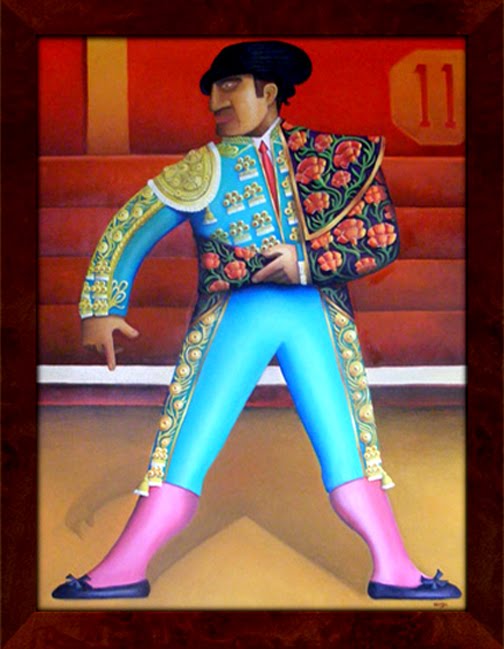
The Bullfighter. Ready. And now what?


Well, after approximately two years, two years! ...of painting, stopping, painting, changing, correcting, being lazy, and painting some more, I finished The Bullfighter. I thought I saw this bullfighter almost finished many times, but I was wrong, it needed more of this, more of that, etc. This bullfighter had fallen forgotten in the back of my mind many, many times. It took so long to rescue him and finish him. I really hope you like it. I finished it a couple of months ago, now it hangs framed, in one of the walls of our restaurant. It is the biggest painting.

What did I learn from all this? ...I learned that I loved painting in this large format (4' x 5'), and I also learned that this is the last time I wait so long to finish something I started.

And now what?
Like I said previously, I finished this painting a few months ago, an this time I’m not going to wait to start a new one.
I will paint again some traditional character or street vendor from the city where I grew up (Lima, Perú), somebody I remember. This time I will go back to some food street vendor. I’m pretty sure this time will be a “Picaronera”, which is commonly a lady that sell “Picarones” which are something similar to doughnuts, with lots of syrup on the top check: http://en.wikipedia.org/wiki/Picarones

My 4x5 canvas is waiting. White, empty, just waiting to be the home of my next character.

Best regards,

Hugo

Monday, September 28, 2009

The Final Stretch


I Can’t even believe it myself. The last time I posted on this blog, was in March of this year, and that was because I thought I was just about to finish this painting, this Bullfighter. But it wasn’t like that. A lot of things came up, and little by little I started to drift away from getting to finish the painting, and before I knew it, I had completely stopped painting. Excuses? …I could blame everything and everybody for this. Too much work, my kids’ homework, too tired, etc., etc. , etc… but the truth is that I’m the only one to blame. No excuses. I believe that if you really want to do something, you can.

My painting stands in my studio, that would be in my dining room. Every day I would see this Bullfighter and I would ask myself when would I finish it. My wife and my kids would also ask the question …WHEN?! …man, I’m even ashamed when I remember that I started this painting on December 24th of last year (2008) …that’s about a whole year! …a whole year!

But now I can say I’m back. I can say I’m on the final stretch. This is the third weekend I’ve been painting. Better put, this is the third weekend I’ve been finishing it. I say “finishing it” because I really feel it that way. The time I’ve spent painting during these days has grown, and that’s a good sign. I been getting more involved again with the smell of the oil paint, and I’ve been getting more involved again with the thickness that I feel when the brush travels from one side to the other leaving a beautiful track of color. When I’m painting, I’ve begun to feel again that pleasure I feel every time I take two or three steps back to see the whole painting, the complete image, and I like what I see.

But it ain’t all pleasure. I paint by instinct. I wasn’t artistically educated. I paint what I like, because I like it, and how I like it. I paint the way I think it should be, the way my “gut” tells me how, or without knowing how it should be. That’s why the way I paint takes me through a world filled with situations and emotions, frustration, pride, anxiety, sadness, happiness, ignorance, discovery, creativity, satisfaction, rush, calm, patience, impatience. May be if I really knew how painting should be done, my experience wouldn’t be so chaotic.

But to be honest with you, and myself, I would like to keep that “chaos” alive. I believe that the end of a chaos is always something positive, a great satisfaction. May be is that challenge of accomplishing something without really knowing how, is what keeps me painting. And it is also my curiosity of finding out how the painting will look when finished.

Let’s stop this complicated “personal philosophy ” of mine. Two days ago was the 25th anniversary of the death of the bullfighter “Paquirri”. If you’ve read my previous posting on this blog, you would know that this painting is inspired by the Bullfighter I just mentioned, a bullfighter I had the chance to meet and shake hands with when I was a child, he was wearing a “suit of lights” I’m painting as I remember it.

I still have a lot of painting to do. Lots of details to finish up. But I wanted to share with you how this Bullfighter is coming along. I selected three important phases of the process, it was hard because each step is as important, but I selected the three phases that can show you the process the best.

Peace.

Sunday, March 22, 2009

One Stroke at a Time


What I find hard to do, is to take control. The passion that drives me to paint is transformed into this powerful energy and strength that needs to be controlled, so I don’t end up damaging the canvas. This energy I talk about needs to change from physical to emotional at my fingertips. It cannot be added to the brush.

I was chosen by my style of painting, I didn’t choose it ...don’t ask me why, but at this moment this style of painting is what’s coming out of me. Detailed oriented, short strokes, carefuly-chosen colors ...one stroke at a time. I would’ve wanted something a little more physical, with speed, long strokes, lots of imperfection, that’s something that seems to fit me better, may be I’ll try it in the future ...but like I said, what you see at this moment is what’s coming out of me.

May be it is the period I’m in right now, may be it is the way I want to tell you the story, or share my memories. may be I just don’t want you to miss any detail of what I have to tell you through the painting. I don’t want you to mis anything.

I had some time to paint over the weekend, I got caught by the detail of the bullfighter’s parade-cape or Capa de Paseo, which is the cape they wear on the left shoulder as they walk into the arena before the fight. I spent a lot of time making decisions on what would go on the cape. I’m liking the wy it’s going.

It must’ve been around 1977 or 1978, I was about 14 years old, I was at the Plaza de Acho, a beautiful bullring in Lima, Perú; it was built in the 1700’s and restored in 1946 or so, I was standing there, at the gate where all the bullfighters need to pass through to get to the ring, I had a piece of paper and a pen, I wanted autographs. I did that every year. All of a sudden, Francisco Rivera “Paquirri”, a very famous Bullfighter scheduled to fight that afternoon, appeared dressed in his suit-of-lights and with a big smile took my paper and pen, gave me his autograph and shook my hand. I was shocked. I will never forget that moment.

One thing I remember very vividly about that moment, is the color of his “traje de luces” (suit-of-lights). It is the color I’ve applied to this painting, it was an aqua-blue and gold. Just the way I saw it. Just the way I remember it. Many people call bullfighting “the dance with death”, and you would think that to an event that’s called that, everybody would be wearing black, but a bullfight is a beautiful celebration of color. That’s ironic.

Francisco Rivera “Paquirri” was killed by a bull in 1984.


Peace.

Sunday, March 8, 2009

74.63% There.


Getting there. I don’t have the luxury of spending every day painting. I have many other duties that at this point in my life, take priority. I’m happy I was able to spend a few hours painting over the weekend. For a long time I felt as if I was stuck. It didn’t matter how much I was painting, it just seemed like I was going nowhere. It felt like I was going to be painting the same thing for the next few years. Never finish.

But!! this weekend I got out of the hole. I clearly see now the ending of this painting, I feel like I just started it, and that’s a good thing. The excitement is back. Of course, I have a few more weeks to go but I know exactly where I’m going and what I have to do.

In every painting I’ve done so far, I’ve found a big hurdle, a big challenge; I encountered situations that I had to figure out by myself (you know, no art book or no painting classes), for example: On the first painting “The Cajonero” the challenge was the feet. How in the hell was I going to paint feet, I’d never done it. So it took some time to play and do it over and over and over...

On the second painting “The Anticuchera”, it was the fire of the grill. Shit! FIRE!! ...I didn’t know how to do it, not only that, Fire brings lighting, so fire had a huge effect on the lady doing the grilling, so it was a little complicated. On the third painting “The Turronera” the challenge was the darkness, I wanted to show a lot of detail, but all this is happening at dusk, plus I wanted to show people in the background, so I had to play with perspective.

And of course, on this 4th painting (no name yet) I also had to get myself in a messy situation: The SUIT OF LIGHTS. I was very excited when I decided to paint the Bullfighter, then I thought: Oh Shit ...what about the suit of lights!!? ...so, I just have to do it. I’m at a point of no return.

That’s all for now, Soon I will tell you the reasons why I painted the bullfighter, why the color of the bullring, and why the purple cape and why the color of the suit of lights. The process continues, and I want to share it with you. The suit of lights is beginning to shape up. But there’s still a lot of work to do.

Peace.

Tuesday, February 10, 2009

The Fourth Painting


A few weeks ago I started my fourth painting. What character? ...you’ll guess, you’ll be able to tell what it is, since I will be posting images of the process. Painting is not that easy, I don’t have an office or a studio, I do it in my dining room, with two kids running around and sometimes arguing as the run, they are my kids, Camila (10) and Matteo (6), plus the telephones, the tv, and more stuff around me.

But I’m not compalining. Actually, I like it that way, I wouldn’t like to have to hide from my kids in order to be able to paint. If I need to concentrate and focus, headphones and good music will be the solution. Besides, every now and then, one of my kids will stand next to me and tell me how beautifull the painting is looking! ...that’s all the support I need.
Kids are so honest, I know if they hate the painting they would say: “I hate that painting”.

I didn’t paint for a few days, I’ve been very busy, very bisy with other things. But I started back. And I feel that in each one of my paintings I evolve, I expect more from myself, I challenge myself. It is the best way to make this journey of painting most rewarding. This painting is going to take longer than the others, it will have more details.

When I paint I don’t do it for one or two hours, I do It for 4 or 5, for 8 hours. I have to prepare for the time that it will take. Like a long drive. Before I start painting, usually I take a cold shower and drink one or two cups of coffee.

La Turronera (The Turrón Street Vendor)


I can never forget the lady in her purple habit, waiting for someone to buy a portion of her delicious Turrón de Doña Pepa. She does it every year. October is the month.

The delicious “Turrón de Doña Pepa” is a very traditional dessert that’s always present during the month of October, month dedicated to the veneration of El Señor de los Milagros (Lord of the Miracles). The image of the also called “Purple Christ” is taken in procession around the city by a large mutltitude. A very important part of this religious tradition is the purple habit worn by the devotees. This tradition has been around for more than 300 years.

As a child I was taken to the procession a number of times. What I remember is a fusion of mistery, sorrow and forgiveness, I remember the smell of the clouds of incense, and I remember the enormous image of the the Christ moving right through them. And of course I do remember the taste of a Turrón de Doña Pepa after the procession (or during). What you see in this painting is what my memories bring back to me from a place called “my childhood” a place that’s many years away from here.

More information about El Señor de los Milagros: http://es.wikipedia.org/wiki/Señor_de_los_Milagros_(Lima)

More information about Turrón de Doña Pepa: http://www.baluart.net/articulo/el-origen-del-turron-de-dona-pepa

La Anticuchera (The Anticucho Street Vendor)


The “Anticucho” (beef heart Kabob) is one of the most popular dishes in Perú. They are traditionaly sold by street vendors around the cities. It is very tipycal to stop by an “Anticuchera” and have Anticuchos for a quick meal. Anticuchos are normaly accompanied by “Choclo” (corn-on-the-cob) and“PapaDorada”(golden potato). I lived in the district of Jesus María in Lima, and about two blocks from my house, in a corner, a group of Anticucheras would gather every night for some serious grilling. The aroma was as good as the taste, but the aroma had the advantage of being able to travel for blocks around the neighborhood and grab you by the nose to bring you to that corner I’ll always remember. The colors I remember of that scene are reresented very closely in the painting. The green wall, the blue cart, the red and purple clothes, the fire of the grill, I remember very vividly.

El Cajonero (The Cajon player)


The “Cajón” (wooden box) is a very important percussion instrument in the folkloric music of Peru. This instrument plays its most important role in the Afro-Peruvians rythms, which were originated due to the arrival of african slaves to the coasts of Perú during the colonial period. I wanted to communicate the deep emotion in wich this instrument is played. The Cajón is also used in more contemporary music, like the peruvian “Vals” (waltz), in the 1970’s, the cajón is taken to Spain and it is adopted to play an important role in the beautiful Flamenco music. Today, the Cajón is also used in Rock.

If you would like a Cajón, I’m sure you can get it here in the states, for about $100 to $200, they’re nice, very well built. But I would recommend you take a little trip to Perú, enjoy the food, the beaches, the cities, the history and before you get back to your hometown, buy a great sounding real cajón for less than $20.
I started painting a couple years ago. I chose oil as the medium, because I felt that it would be challenging, and yet, flexible. And traditional. I didn’t go to art school, I paint by instinct and my memories are my resources. I spent most of my teenage years drawing cartoons and caricatures, I used watercolor and then a black pen around the edges.

WHY THE BIG PAINTINGS - My wife Estella and I own a peruvian-cuisine restaurant in Miami Beach, named El Rincón de Chabuca (I will explain the nature of the name some other time) the interiors walls of the restaurant are big, and it would take a number of pictures to fill them up, so we decided to get pictures of a decent size.

I began to look for the right images. I wanted big peruvian scenes or characters, but everything I found were images of the mountains (the Andes), everyday scenes of andean people with their llamas, and the women with their baby on their backs. Typical paintings. Beautiful. Nostalgic. But every peruvian restaurant has something similar, besides, I DO NOT IDENTIFY WITH THOSE IMAGES. I was raised in the coast of Peru, Lima, the capital.

As much of a shame that it can be, I’ve never been to the Andes. But in Lima there are as many stories and scenes, and characters that I saw as I was growing up. I wanted images of characters, vendors, musicians, etc, that I remember, and that are very traditional in the every day life in the Lima I lived.

After a long and frustrating search for the right imagery to hang in the walls of my restaurant, I gave up. However, I figured that if at one point in my life, I drew and painted these little cartoons and caricatures on small pieces of paper about 30 years ago, I could tary to do it again, in a much bigger scale.

I chose a format of 3' x 4'. Good size. I didn’t want to try first in a small scale, and then bigger, and then bigger, and then... I wanted to go for the big size from the beginning, and if I failed and the painting didn’t satisfy me, I WOULD JUST THROW IT AWAY!! ...nobody would have to know about this, just my wife and kids.

So I painted “El Cajonero”. I liked it. and people responded very well. That’s how all this started. Hopefully people will like my work. And for the people that think that Perú is all about llamas and andean music I believe that with my images and the stories that come with them I would be able to open their minds a little more.